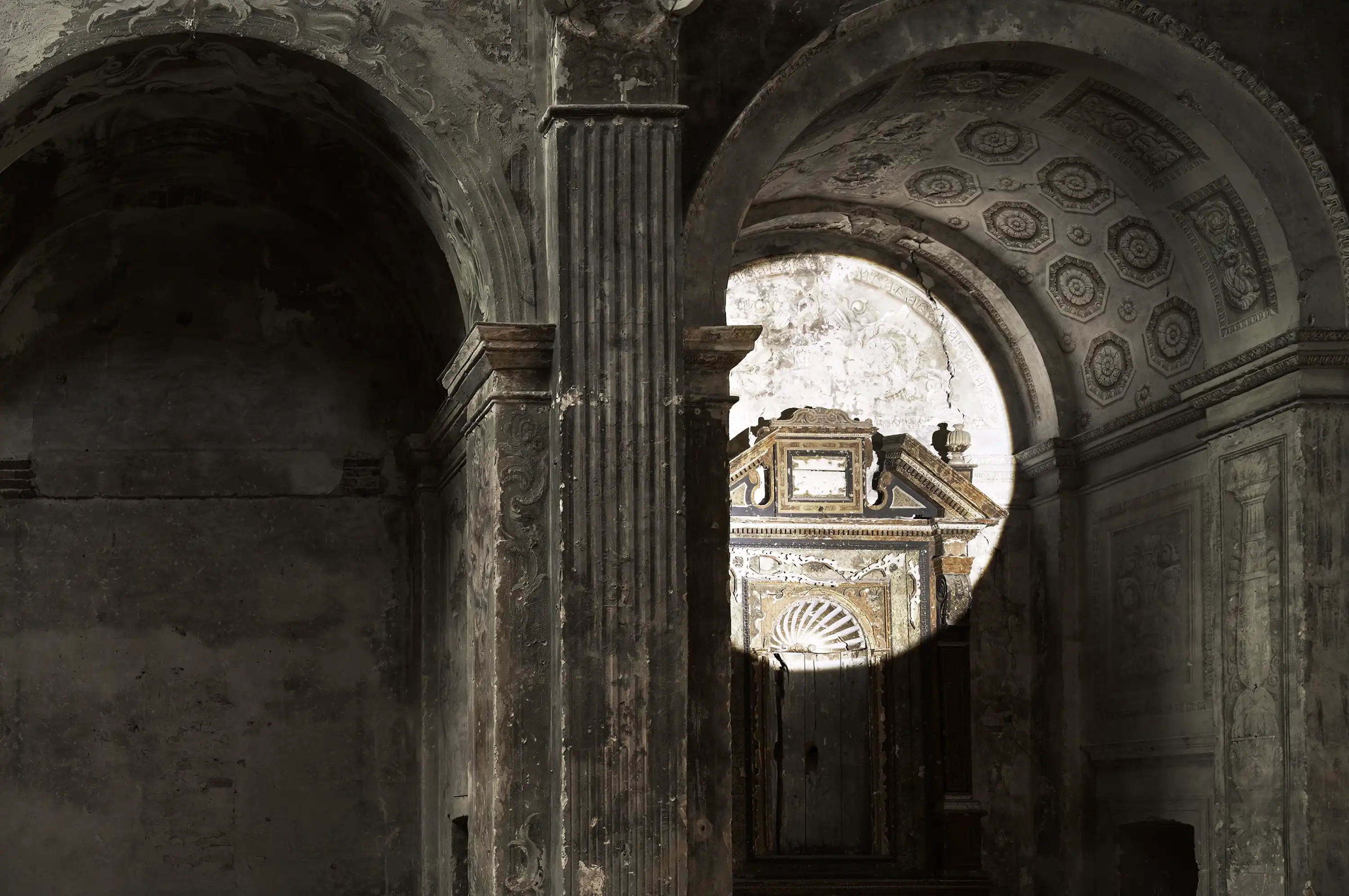
Ten principles define how San Carlo works. They provide an enduring framework for its choices and
articulate the project in its most essential form.
1. INDEPENDENCE
San Carlo was founded as an autonomous initiative, outside conventional models of institutional
programming. This independence continues to shape its approach: making considered choices,
remaining closely involved in each project, and allowing research and the work itself to determine the
time, form and conditions they require.
2. PLACE
The church’s architecture, light, acoustics, proportions and traces of time enter into every project.
The site is an active presence within the work, shaping its form and the way it is perceived.
3. ARTISTS
The programme begins with encounters with artists and a close engagement with their research. An
invitation takes shape when San Carlo can offer conditions that open a new direction: a different
scale, an idea to test, a work to develop, a possibility still taking shape.
4. COMMISSIONING
The production of new work is central to San Carlo’s purpose. Research, site visits, conversations,
planning and realisation form a single process, developed with the artist so that an idea can find a
new, precise form rooted in this place.
5. SPECIFICITY
A work may be conceived for San Carlo or arrive with a history of its own. Its particular presence
emerges through its relationship with the space, its placement and the duration of the exhibition.
6. TIME
Each project unfolds in its own time. Research, production, installation and opening follow the rhythm
the work requires. The project determines the calendar.
7. CONSEQUENCE
An exhibition lives on through what it makes possible: a development in an artist’s research, a new
relationship, a direction brought into focus, an opening towards new interlocutors and contexts.
8. PRESENCE
An encounter with a work asks for time and attention. The arrangements for visiting are part of the
project, shaped to encourage a direct relationship between the work, the space and those who move
through it.
9. RELATIONSHIPS
From Cremona, San Carlo builds an open, international cultural geography. Artists, curators,
museums, foundations, galleries, collections, writers and publishers become involved in the projects,
helping them grow and circulate beyond their place of origin.
10. MEMORY
Photographs, films, texts, publications and research materials accompany and document each
exhibition. Over time, they form an archive of the works, processes and relationships that San Carlo
has helped make possible.